
Published July 2026 by BuzzPilot
You need a website. You’ve seen Wix and Squarespace ads promising a site in an hour. You’ve seen agencies quoting $3,000 to $5,000. The gap between free and five thousand dollars feels enormous. And nobody is explaining what you actually get at each price point.
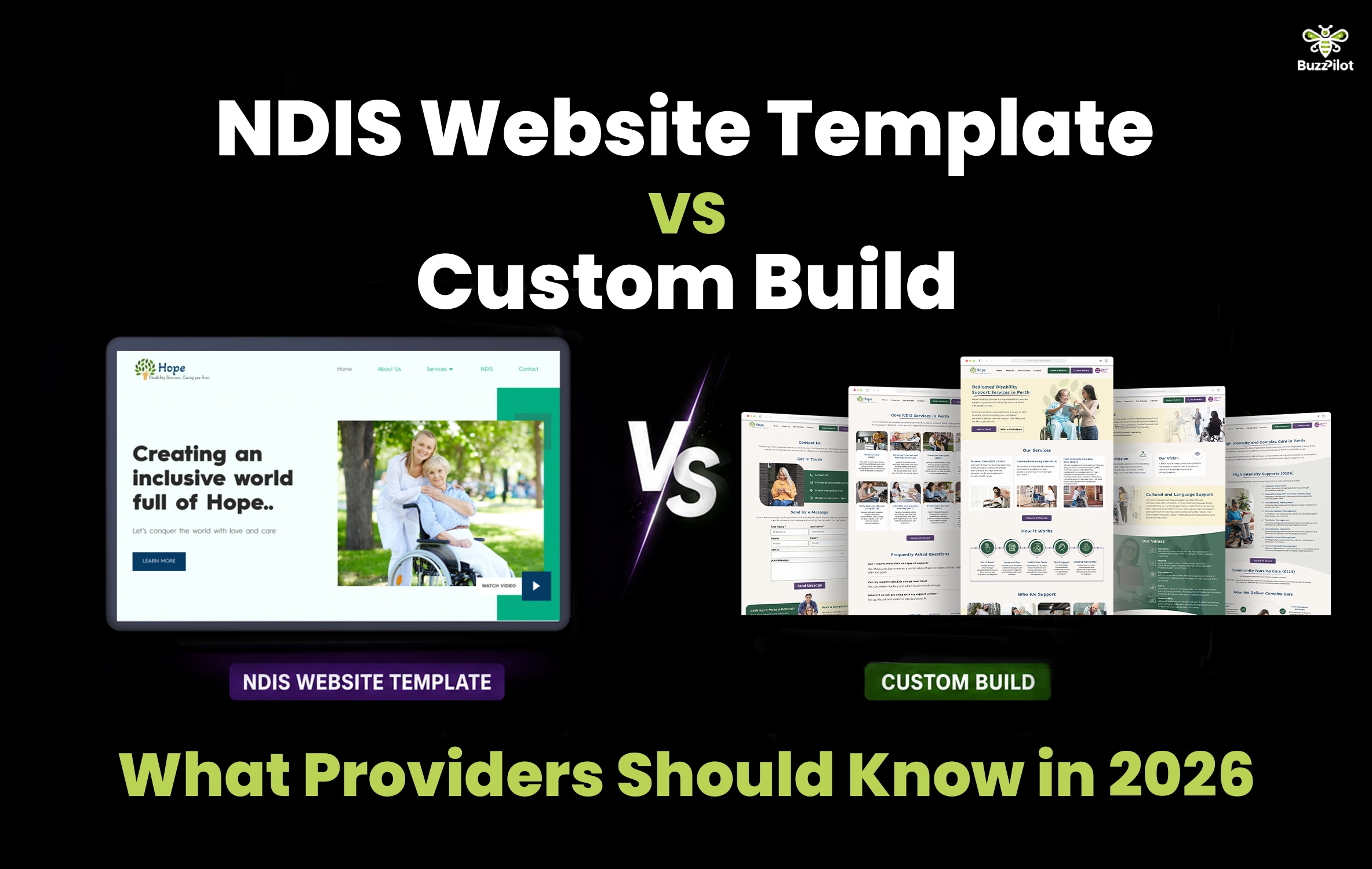
An NDIS website template gets you online fast. A custom build gets you found, trusted, and referred to. Those are different outcomes. The right choice depends on what the website’s job actually is.
This article compares NDIS website templates and custom builds honestly. Not to sell custom builds. To help providers understand what each option delivers and what it doesn’t so the decision is based on facts, not fear or budget pressure.
What an NDIS Website Template Actually Gives You
A Wix, Squarespace, or free WordPress theme gives a website in hours. Pick a template, swap the logo, add text, and publish. Cost: $0 to $500 plus monthly hosting. Speed: same day.
For a provider who just got registered and needs something online immediately, this works as a starting point. It’s better than having no website at all. A coordinator who Googles the provider name and finds a basic website sees a business that exists. That’s worth something.
But what an NDIS website builder delivers out of the box and what an NDIS provider website actually needs are usually two different things.
The template gets a provider online. It doesn’t get the provider found on Google. It doesn’t meet compliance requirements. It doesn’t convert coordinator visits into referrals. It’s presence without function.
Where Templates Fall Short for NDIS Providers
This is not about aesthetics. A template can look as good as a custom site. The gaps are structural, compliance-related, and invisible to most providers until they realise the site isn’t generating enquiries.
Compliance
NDIS provider websites need accessible complaints forms, current privacy policies, visible registration details, and WCAG 2.1 AA accessibility. No template platform includes these by default. Most providers using templates don’t add them because they don’t know they need them.
Complaints forms need to be accessible from every page. Privacy policies need to reflect actual data collection practices. Registration numbers need to be visible on the homepage and footer. These are audit-relevant elements.
For the full compliance requirements, read this guide. For the compliance checklist, read this breakdown.
Individual Service Pages
A template typically gives one “Services” page. NDIS providers need individual pages for each registration group: SIL, support coordination, community participation, personal care, plan management, therapeutic supports.
One page per service is how Google matches a site to what coordinators search. A coordinator searching “SIL provider Dandenong” needs to find a page specifically about SIL. A single services page listing everything won’t rank for any specific query.
For what every NDIS website should include, read this guide.
Referral Pathway
Templates have generic contact forms. NDIS providers need a dedicated “Refer a Participant” page built specifically for coordinators. This is the single highest-converting element on any NDIS website and no NDIS website builder includes it by default.
A coordinator should be able to refer a participant in under a minute. Simple form. Coordinator details. Participant location. Service required. Urgency indicator. The referral goes directly to the right person.
To understand why this matters, read how support coordinators choose NDIS providers.
Suburb Targeting
Templates don’t target suburbs. NDIS providers need location-specific content for every suburb serviced. Without it, Google has no reason to rank the site when a coordinator searches “NDIS provider [suburb].”
A provider covering Dandenong, Frankston, and Werribee needs content that mentions those suburbs specifically. Not “we serve Melbourne.” Specific suburb references in service pages, meta titles, and content throughout.
SEO Structure
Most templates generate poor heading hierarchy, missing meta titles, no schema markup, and no internal linking. The site might look fine but Google can’t read it properly.
Schema markup tells Google exactly what the business is, what services are provided, and where. Without it, Google relies on guesswork. Heading hierarchy tells Google what’s important on each page. Without proper H1, H2, H3 structure, pages don’t rank as well as they should.
Accessibility
WCAG 2.1 AA compliance requires keyboard navigation, screen reader compatibility, colour contrast ratios, alt text on images, and properly labelled forms. Most templates fail these tests without significant manual work.
For an NDIS provider working in the disability sector, an inaccessible website is both a compliance risk and a trust problem. A coordinator checking a provider’s site on behalf of a participant with vision impairment expects the site to be accessible. If it isn’t, that says something about the provider.
Speed
Template platforms load third-party scripts, unoptimised images, and bloated code. Page speed directly affects ranking and user experience.
Coordinators search on phones between appointments. They’re checking providers while waiting for a meeting or between home visits. A site that takes four seconds to load gets closed. A site that loads in under two seconds gets read.
What a Custom NDIS Website Gives You
A website built specifically for an NDIS provider includes everything the sector requires from day one.
Individual service pages for every registration group. Dedicated referral pathway for coordinators. Compliant complaints form and privacy policy. WCAG 2.1 AA accessibility built in. Suburb-level content targeting actual service areas. SEO-ready structure with proper headings, meta titles, and schema markup. Google Business Profile setup. Mobile-first design that loads fast. Full ownership of domain, hosting, files, and content.
The difference isn’t aesthetics. The difference is structure, compliance, and visibility.
A custom NDIS website is built for how coordinators search, what auditors check, and what converts a site visit into a referral. The best NDIS websites work across all three of those dimensions simultaneously.
To see what this looks like in practice, read the Mickleham Healthcare case study. A provider covering 16 registration groups across Victoria, built from zero with full brand identity and website. Or Hope Disability Services. A Perth provider who went from no website to a compliant, referral-ready site in under two weeks.
To see what separates NDIS websites that generate referrals from ones that don’t, read this analysis.
When a Template Is Enough
Some providers don’t need a custom build right now. Being honest about this matters.
A template is enough if:
You just got registered and need something online within 48 hours. A placeholder while you plan a proper build is better than nothing. Coordinators who Google your business name will find something. That’s a starting point.
You’re a sole trader delivering one service in one suburb. If your entire business is personal care in one suburb and you get referrals through personal relationships, a basic site that shows you exist may be sufficient for now.
Your budget genuinely cannot stretch beyond $500 right now. Some providers are starting with minimal capital. A template lets them get online while they build revenue.
In these cases, a template is better than no website at all. But go in knowing it won’t rank on Google for service searches, it won’t meet compliance standards without significant manual work, and coordinators searching for providers in your suburb probably won’t find it.
A template is a digital business card. Not a referral tool.
When You Need a Custom Build
Most NDIS providers fall into this category. The question is whether they know it before or after months of an underperforming template site.
You need a custom build if:
You’re registered across multiple service categories. SIL, support coordination, community participation, personal care, plan management. Each needs its own page. A template won’t create these.
You service multiple suburbs. You need to be found on Google in each area. Suburb-level content targeting requires intentional NDIS website development, not a template swap.
Coordinators are your primary referral source. You need a referral pathway they can use. You need to appear when they search. Templates don’t deliver either.
You’ve been through an audit or are preparing for one. Compliance elements need to be in place. Complaints form. Privacy policy. Registration visibility. WCAG accessibility.
Your current template site isn’t generating enquiries despite being live for months. This is the most common trigger. The site exists. Nobody finds it. Nobody refers through it.
If any of those apply, a template is costing referrals every week it stays live. Not because it’s ugly. Because it’s invisible to search and non-compliant to auditors.
For a detailed breakdown of what NDIS websites cost in 2026, read this pricing guide.
The Ownership Question
This is a practical consideration most providers don’t think about until it’s too late.
With most template platforms, you don’t own the website. You rent it. Stop paying the monthly fee and the site disappears. You can’t export the design to another platform. You can’t move it to another host. You’re locked in.
Years of content, reviews, and SEO progress disappear if you stop the subscription or if the platform changes its terms.
With a custom build (depending on the NDIS web developer), you should own everything. Domain registration in your name. Hosting you control. Files you can download. Content you created. If you leave the agency, you take it all with you.
Not every agency offers this. Some retain ownership. Some use subscription models where you lose access if you stop paying. Some charge “release fees” to give you your own files.
Ask before you sign. Full ownership should be standard.
The Ongoing Visibility Question
A website launches once. Visibility builds over time.
Even a well-built NDIS business website development project needs ongoing work to rank on Google. Content updates. New suburb pages as service areas expand. Blog posts that demonstrate expertise. Technical maintenance. Review acquisition.
This is where SEO for NDIS providers becomes relevant. The website is the foundation. Ongoing SEO builds the visibility that generates consistent referrals month after month.
A template site can’t support this kind of ongoing optimisation. The technical foundation isn’t there.
The Question to Ask Before You Decide
Before choosing between an NDIS website template and a custom build, answer this:
Is the website’s job to exist or to generate referrals?
If you just need proof you’re a real business, a template works. It’s fast. It’s cheap. It puts something online.
If you need coordinators to find you on Google, trust what they see, and refer participants through your site, you need a website built for that purpose. That’s NDIS website development with compliance, referrals, and visibility built in from day one.
For a full breakdown of what separates NDIS websites that generate referrals from ones that don’t, read this analysis.
Book a Free Website Audit
If you're using a template and not getting referrals, or if you're planning your first NDIS website and want to get it right, book a free website audit.
We'll review what you have, what's missing, and whether a rebuild is worth it for your situation. Honest assessment. No obligation.