Google Ads usually wins for participant enquiries, because participants, families and support coordinators are already searching for a provider. Facebook and Instagram ads usually win for awareness, SIL and SDA vacancies, and support worker recruitment.
That’s the short answer to Facebook ads vs Google Ads for NDIS providers. The real worry is spending a limited budget on the wrong platform and getting clicks that never become participants.
This guide gives a verdict for each goal and situation, and shows how to judge both platforms on results that matter. It’s written by an NDIS marketing agency that runs both, so there’s no platform to push.
The Short Answer: Which Platform Wins for Which Goal
Goal | Better platform | Why | What to measure |
Participant enquiries for an existing service | Google Ads | People search for a service and area when they need support | Enquiries that become service agreements |
Support coordinator referrals | Google Ads | Coordinators search by service and location to find providers | Referrals received and accepted |
New service or area launch | Meta ads, then Google | Nobody searches for a provider they haven’t heard of | Enquiries from the new area, then participants |
SIL or SDA vacancy | Meta ads | Vacancies need awareness among families, carers and coordinators who aren’t searching | Qualified enquiries and placements |
Support worker recruitment | Meta ads | Good workers are rarely searching job boards | Applications, then hires |
Brand trust with local families | Meta ads | Real faces and stories build familiarity before someone needs a provider | Engaged local audience, then enquiries |
How Google Ads Works for NDIS Providers
Google Ads shows your ad when someone searches for what you offer. That intent is what makes it the strongest channel for most participant enquiries.
The searches that matter usually combine a service and a location. Examples include “SIL provider Geelong”, “in-home support Joondalup” or “community access NDIS Ipswich”. The person typing them has a need and usually wants to act soon.
Support coordinators search the same way when they’re looking for providers with capacity. Our guide on how support coordinators choose NDIS providers covers what they check once they reach your site.
Because searches are specific, enquiries tend to come faster and are easier to track. You can see which search, ad and page led to each call or form.
The downsides are real:
- Cost per click. Competitive service terms in busy areas can be expensive.
- Reach. Google only reaches people already searching, so it can’t create demand for a new service.
- Broad keywords. Loose targeting attracts job seekers, students and people outside your area.
- Homepage traffic. Ads sent to a general homepage waste clicks that should land on a service page.
- Remarketing limits. Google restricts personalised advertising based on health conditions, so don’t plan remarketing around disability. Check current policy before launching.
For how we run search campaigns, see Google Ads for NDIS providers.
How Facebook Ads Work for NDIS Providers
Facebook and Instagram reach people before they search. That makes Meta strong for the jobs Google can’t do.
Targeting is more limited than many providers expect. Meta has removed detailed targeting options tied to sensitive topics such as health. You can’t target people by disability, diagnosis or NDIS participation. Check current policy before launching.
Realistic targeting relies on location, broad audiences, custom and lookalike audiences built from data collected with consent, and creative that speaks clearly to the right people. An ad describing in-home support in a specific area attracts the people it’s meant for.
Meta does several things well for NDIS providers:
- Reaching families and carers in your service area before they need a provider.
- Promoting SIL and SDA vacancies to families, carers and coordinators in the region.
- Recruiting support workers in the suburbs you need covered.
- Building trust through real faces and stories, with written consent from anyone featured.
The risks are lower intent, more variable lead quality and higher creative demands. Cheap leads from easy lead forms often never answer the phone. For the full guide, see NDIS Meta ads.
Paid ads also work better when your organic presence looks active. That’s the job of NDIS social media marketing, which is separate from paid campaigns.
Facebook Ads for Support Worker Recruitment
Recruitment is often Meta’s strongest use for NDIS providers. Good support workers are rarely scrolling job boards, but they are on Facebook and Instagram.
Specific ads work best. Name the suburb, shift pattern, type of support and what makes your team a good place to work. Screen applicants with short questions about location, availability and NDIS Worker Screening Check status.
Recruitment ads may fall under Meta’s employment-related special ad category, which can restrict targeting options. Check whether your ad falls under a special ad category before launching.
Google Ads vs Facebook Ads for NDIS Providers: Side-by-Side
Factor | Google Ads | Facebook/Meta Ads |
Audience intent | High. People are searching for a service | Lower. People are scrolling, not searching |
Speed to first enquiry | Fast once campaigns are live | Fast with a strong offer, slower for awareness |
Lead quality | Usually higher, from specific searches | More variable, needs screening and follow-up |
Targeting limits for health and disability | Search works on what people type; personalised ads based on health are restricted | No targeting by disability, diagnosis or NDIS participation |
Creative needs | Clear ad copy and a matching service page | Real images or video, a clear message and an offer |
Best ad format | Search ads to a specific service page | Video or image ads to a landing page or screened form |
Main risk | Paying for broad or irrelevant clicks | Cheap leads who never become participants |
Typical first use | Participant enquiries for core services | Recruitment and vacancy awareness |
Which Should You Start With?
New provider with no ads running
Start with Google Ads. Capture people already searching for your core services in your area before spending on awareness. Once you know what a participant costs from search, add Meta for recruitment or a new area.
Established provider with empty SIL or SDA places
Start with Meta ads. Vacancies need awareness among families, carers and coordinators who may not be searching right now. Show the home, the area and the support model, and give coordinators a clear way to refer.
Provider struggling to hire support workers
Start with Meta ads for recruitment. It’s usually the fastest way to reach workers in specific suburbs. Run recruitment campaigns separately from participant campaigns so you can judge each on its own results.
Provider with a budget for both
Run both, with clear jobs for each. Google catches participants and coordinators searching now. Meta builds awareness, fills vacancies and finds staff. Judge each platform on enquiries that become participants or hires, not on clicks or reach.
How to Split Your NDIS Advertising Budget
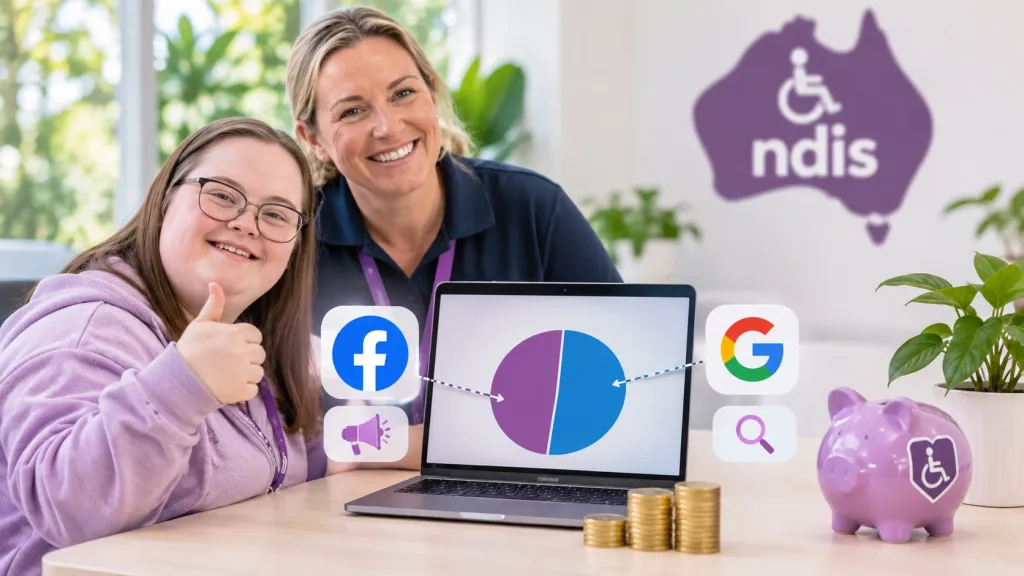
There’s no benchmark split that suits every provider. Start where intent is highest, prove your cost per participant, then expand. For most providers chasing participants, that means Google first.
Use this formula. Monthly ad spend divided by new participants (or hires) equals cost per participant. Compare that with the yearly value of one participant to your organisation.
A hypothetical example. These figures are made up to show the method, so use your own. Say you spend $1,500 in a month on search ads and sign three new participants. Your cost per participant is $500. Compare that with what one participant is worth to your organisation over a year, using your own figure.
Some things must be in place before either platform works:
- A fast service page for each service. Ads should land on the page for what was searched, not your homepage. Proper NDIS website design makes this possible.
- Call and form tracking. Without it, you can’t tell which platform brought which participant.
- Same-day enquiry response. Enquiries go cold quickly. A named person should respond the same day.
For the wider picture beyond paid ads, see our guide on how NDIS providers generate leads.
Mistakes NDIS Providers Make With Both Platforms
- Boosting posts instead of running campaigns. Boosts chase likes. Campaigns can be built around enquiries and applications.
- Sending traffic to the homepage. People shouldn’t have to hunt for the service they clicked on.
- No conversion tracking. Without it, every budget decision is a guess.
- Slow follow-up. An enquiry contacted days later has often gone elsewhere.
- Participant images without consent. Get written consent before featuring any participant in an ad.
- Misleading or outcome-guarantee copy. Ads must not make misleading claims under the NDIS Code of Conduct, and allied health providers must follow AHPRA rules on testimonials. Our guide to NDIS website compliance covers the same principles for your site.
- Judging Meta on reach and Google on clicks. Neither pays for itself. Judge both on participants and hires.
FAQ
For participant enquiries, Google Ads is usually better, because participants, families and coordinators search for a service and location when they need support. Facebook and Instagram ads are usually better for support worker recruitment, SIL and SDA vacancies, new area launches and building local trust. Most providers should start with Google, then add Meta.
No. Meta has removed detailed targeting options tied to sensitive topics such as health, so you can’t target people by disability, diagnosis or NDIS participation. Use location, broad audiences, consented custom audiences and clear creative instead. Our guide to Meta ads for NDIS providers explains realistic targeting. Check current policy before launching.
Often, yes. Recruitment is one of the strongest uses of Facebook ads for NDIS providers. Name the suburb, shift pattern and support type, and screen applicants with short questions. Recruitment ads may fall under Meta’s employment-related special ad category, so check current policy before launching.
There’s no single right figure. Work out what one new participant or hire is worth to your organisation, then compare it with your cost per participant or cost per hire. Start with a budget you can sustain for a fair test on one platform, prove the numbers, then expand.
No. NDIS participant funding pays for supports for participants. It can’t be used to pay for a provider’s advertising, marketing or other business costs. Advertising is a business expense your organisation funds directly. Speak to your accountant about how it’s treated for tax purposes.
Yes, once you have the budget and tracking for both. Give each platform a clear job: Google for participants and coordinators searching now, Meta for recruitment, vacancies and awareness. Track each separately so you know what each one produces in participants and hires.
Get a Clear Advertising Plan for Your NDIS Organisation
BuzzPilot runs both Google Ads and Meta ads for NDIS providers, so the recommendation follows your goals. We're based in Perth and work with providers across Australia remotely.
See our NDIS Google Ads management or read the Hope Disability Services case study to see work for a Perth provider. That case study covers website work, not ad results.